2026-07-10T18:30:00.000Z
Apr 22, 2026 News Article
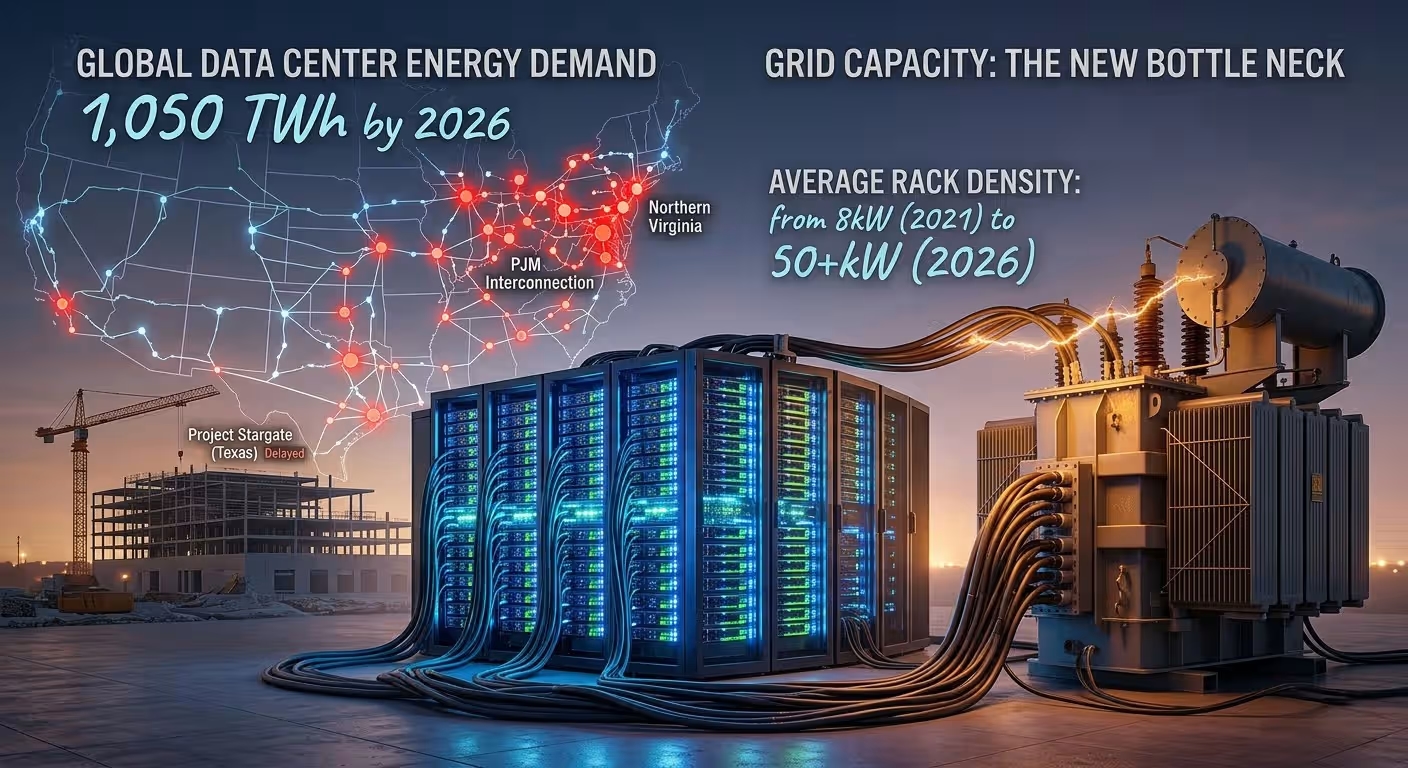
Northern Virginia stopped accepting new data center permit applications. Not because it ran out of land. Because it ran out of electricity.
That detail gets buried in a story that has been framed almost entirely around chips, models, and compute benchmarks. But ask any grid operator in the mid-Atlantic region what keeps them up right now and you'll get the same answer: AI.
The IEA put global data center electricity consumption at 415 terawatt-hours in 2024. Roughly 1.5% of everything generated on earth. That number has been climbing at about 12% per year since 2017, which is more than four times the rate of total electricity demand growth. A Brookings Institution briefing updated earlier this month puts a plausible 2026 total near 1,050 TWh. Counted as a country, the data center sector would sit between Japan and Russia on the list of the world's largest energy consumers.
That ranking will move up, not down.
The Lawrence Berkeley National Laboratory projects US data centers will account for between 6.7% and 12% of domestic electricity by 2028. The range is deliberately wide. Nobody knows exactly how fast AI inference demand scales in practice, and any analyst who tells you otherwise is selling a model, not a forecast. What the numbers do agree on: the 2023 US baseline was 4.4%. The IEA's own base case reaches 945 TWh globally by 2030, growing at 15% annually. That is roughly Japan's entire current national electricity consumption, added to the grid in a single decade.
Previous waves of data center construction were diffuse. Traffic, streaming, cloud compute. Demand was heavy but it spread across hundreds of facilities in dozens of regions. Interconnection requests were manageable. The grid absorbed them.
AI clusters don't work that way. A single large-scale training facility draws between 100 megawatts and 1,000 megawatts of continuous power. That is the electricity footprint of a mid-sized city, concentrated on one interconnection point, requested on a timeline the grid was never designed to accommodate. Average rack densities doubled between 2021 and 2024, from 8 kilowatts to 17. Racks running current AI workloads regularly exceed 50 kilowatts. The infrastructure serving the first number was not built for the third.
PJM Interconnection manages electricity for roughly 65 million Americans across 13 states. As of early 2026, PJM is projecting a 6-gigawatt reliability shortfall by 2027. Capacity market prices in the region climbed from roughly USD 60 per megawatt-day in 2024 to more than USD 300 per megawatt-day in 2025, a fivefold jump in under 18 months. Goldman Sachs estimates data center demand will add 0.1 percentage points to core inflation in both 2026 and 2027. That is not an abstraction. Those costs are already appearing on household electricity bills.
A lot of infrastructure coverage gets this wrong. Everyone has capital right now. Hyperscalers, sovereign wealth funds, private equity. The binding constraint isn't money. It's transformers, switchgear, and grid interconnection slots, none of which respond to a term sheet.
High-voltage transformer lead times have stretched to two to three years in many markets. Gas turbines, still the fastest route to new dispatchable generation, are booked well past 2028. The IEA warned in its latest report that without accelerated investment in transmission infrastructure, up to 20% of planned data center projects face significant delays. That's roughly one in five projects already in the pipeline, stalled not by a lack of demand but by a manufacturing and permitting queue that precedes the current AI boom.
You cannot spend your way around a five-year supply chain.
OpenAI's Stargate project is the clearest example in the public record. Announced at a USD 500 billion price tag and framed as the largest AI infrastructure investment in US history, the Texas development had produced no significant physical construction as of mid-April 2026, per industry observers. The stated reason isn't funding or political will. It's the same bottleneck stalling projects across Virginia, Ohio, and Georgia: power delivery timelines that don't bend to press release schedules.
Microsoft has locked in long-term nuclear capacity agreements to secure dispatchable power that doesn't fluctuate with gas markets. Amazon contracted large-scale solar in Texas. Google has deployed liquid cooling in certain AI clusters, cutting power overhead on those workloads by a measurable margin. Together, these moves underscore the growing importance of efficient thermal management and insulation strategies in modern data centers, a trend explored in the Global Data Center Insulation Market report.
They're also future-dated. None of them clear the interconnection queue that's blocking permits today.
The IEA notes that AI could eventually help stabilize grids by improving load distribution and demand forecasting. That feedback loop hasn't started. The energy sector has been slow to adopt AI tools, held back by data access restrictions and cybersecurity concerns that consistently take priority in budget conversations. The sector that most needs AI to run better is also the sector most reluctant to run on it.
Power availability is now the primary variable in AI infrastructure planning. Not compute cost. Not model performance. Megawatts. The companies that locked in power contracts and grid interconnection in 2023 and 2024 have a structural advantage that can't be replicated quickly. For everyone else, the queue is long and the timelines are not shortening.
For enterprises building capital models around AI capacity availability, and for investors pricing the energy transition, the grid is a first-order variable now. The planning frameworks that treat it as a background item haven't caught up to the market that exists in April 2026.
The compute race always had a physical ceiling. We found it.
Sources: IEA, Energy and AI Report | Brookings Institution, April 2026 | S&P Global: IEA Data Center Coverage | ITIF, April 2026 Grid Analysis | Data Center Knowledge, 2026 Predictions | IEA Executive Summary, Energy and AI
Latest Articles
2026-07-10T18:30:00.000Z