
2026-08-09T18:30:00.000Z
Apr 17, 2026 Blog
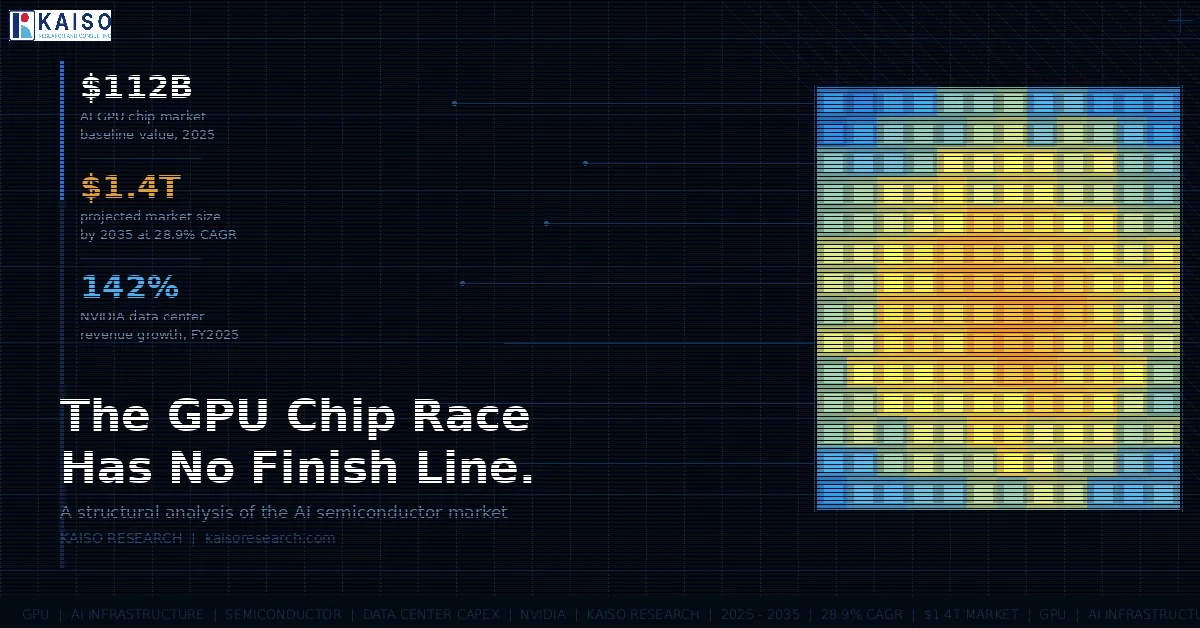
The last time an infrastructure category grew at nearly 29% annually for a full decade, it was cloud computing, and even that undershot early projections. The global AI GPU chip market is now positioned in a structurally similar moment, but with one critical difference: demand is not consumer-driven. It is enterprise and sovereign. According to Kaiso Research, the global AI GPU chip market was valued at $112.07 billion in 2025 and is projected to reach $1,419.12 billion by 2035, expanding at a CAGR of 28.9% during the forecast period 2026-2035. Before accepting or disputing that trajectory, the more useful question is: what structural forces would have to remain intact for that growth to hold?

For most of computing history, semiconductor demand was distributed across consumer devices, automotive, industrial, and telecom, each pulled from different chip categories. AI is doing something structurally different: it is concentrating demand into a single processing architecture at historic speed. NVIDIA's data center revenue, the closest public proxy for AI GPU chip demand, reached $115.2 billion in fiscal year 2025, a 142% increase from the prior year, according to the company's FY2025 SEC filing. That single company's data center segment already approximates the entire market baseline identified for 2025.
What that compression signals is not a bubble. It signals that GPU chips are transitioning from a specialized component to infrastructure-grade hardware, the same transition that hard drives completed in the 1990s and that fiber optic cables completed after 2000. The structural difference is that this transition is happening in years, not decades.

The most cited figure in any AI GPU analysis is NVIDIA's market share. Analysts tracking GPU shipments put NVIDIA's market position at approximately 80-92% of AI accelerator revenue as of 2025. AMD's data center segment delivered $16.6 billion in fiscal 2025, a 32% year-over-year gain, but still roughly 14% of what NVIDIA generated from the same category. The structural reason for NVIDIA's durability is not hardware alone: the CUDA software ecosystem creates switching costs that raw hardware benchmarks consistently understate.

The more credible long-term competitive pressure on NVIDIA's share comes not from AMD or Intel, but from hyperscaler-custom silicon. Google's TPUs, Amazon's Trainium chips, and Meta's MTIA processors are purpose-built for inference workloads where NVIDIA's general-purpose architecture carries overhead that becomes economically visible at scale. How aggressively hyperscalers shift internal workloads to custom ASICs through 2030 will define whether a 28.9% CAGR is a floor or a ceiling for the broader GPU chip category.
The scale of infrastructure commitment behind this market is not speculative. Much of it is already contractual. The top four U.S. hyperscalers, namely Amazon, Google, Meta, and Microsoft, collectively announced capital expenditure plans exceeding $325 billion for 2025, with AI infrastructure accounting for the majority of incremental spending. Microsoft alone committed $80 billion in fiscal year 2025 to data center expansion. McKinsey forecasts 156 gigawatts of AI data center capacity demand by 2030, requiring approximately $5.2 trillion in cumulative capital expenditure.

NVIDIA's own guidance frames data center capital spending as growing at a 40% annual pace between 2025 and 2030, with annual spending potentially reaching $1.5 trillion by 2027. These are not projections extrapolated from historical trends; they are stated corporate commitments from the world's largest technology buyers. The AI GPU chip market's growth trajectory is, in large part, a downstream consequence of decisions already made and publicly disclosed.
The demand case for AI GPU chips is well-documented. The supply case is where the analysis becomes more complicated. Advanced GPU manufacturing depends on TSMC for leading-edge nodes at 5nm and below, a single-manufacturer dependency with no near-term structural alternative. TSMC's 2nm process, which entered mass production in 2025, is essential for next-generation AI accelerators, but capacity allocation is finite and heavily contested across multiple chip categories simultaneously.
SEMI's industry forecasts project wafer fab equipment spending to reach $133 billion in 2025, rising to a record $156 billion by 2027, reflecting the urgency of expanding production capacity. High-bandwidth memory (HBM), the complementary component that determines AI chip system performance, already faces persistent shortage conditions. The gap between announced GPU demand and manufacturable supply is the most underanalyzed variable in any 10-year projection, including Kaiso Research's own modeling for this category.
The 2035 projection of $1,419.12 billion needs to be read in context of what the category contains. The AI GPU chip market encompasses training accelerators, inference chips, edge AI processors, and increasingly, chips purpose-built for agentic AI systems, each carrying different margin structures, different competitive dynamics, and different demand drivers. An independently produced AI chipsets market report, covering a broader category inclusive of GPUs, ASICs, FPGAs, and NPUs, projects a market of USD 459.50 billion by 2035, at a nearly identical CAGR of 37%.
The convergence of independently modeled projections at similar growth rates across methodologically distinct research efforts suggests the structural assumptions are not outliers. The 2035 figure is aggressive by any historical comparison, but it sits within a defensible range given what committed hyperscaler capex has already anchored into the supply chain.
The AI GPU chip market is not growing because AI is culturally popular. It is growing because the economics of AI model development have created a durable, multi-year demand cycle that is structurally unlike prior technology adoption curves. Training a frontier AI model now requires clusters of 100,000 or more GPUs, each consuming over 700 watts, a compute density that did not exist in enterprise infrastructure five years ago.
As inference demand scales alongside training demand, and as sovereign AI strategies across the US, EU, India, and Japan mandate domestic compute capacity, the addressable market expands geographically and institutionally, not just at the hyperscaler level. Dell'Oro Group research notes that GPUs and custom AI chips now represent approximately one-third of total data center capex, making them the leading growth driver across the entire data center value chain.
The $112 billion baseline in 2025 is not a peak. It is, by any reasonable reading of committed capital and publicly stated infrastructure plans, a starting point.
Latest Blogs
2026-08-09T18:30:00.000Z

2026-08-07T18:30:00.000Z

2026-08-07T18:30:00.000Z



