
2026-08-09T18:30:00.000Z
Aug 03, 2025 Blog
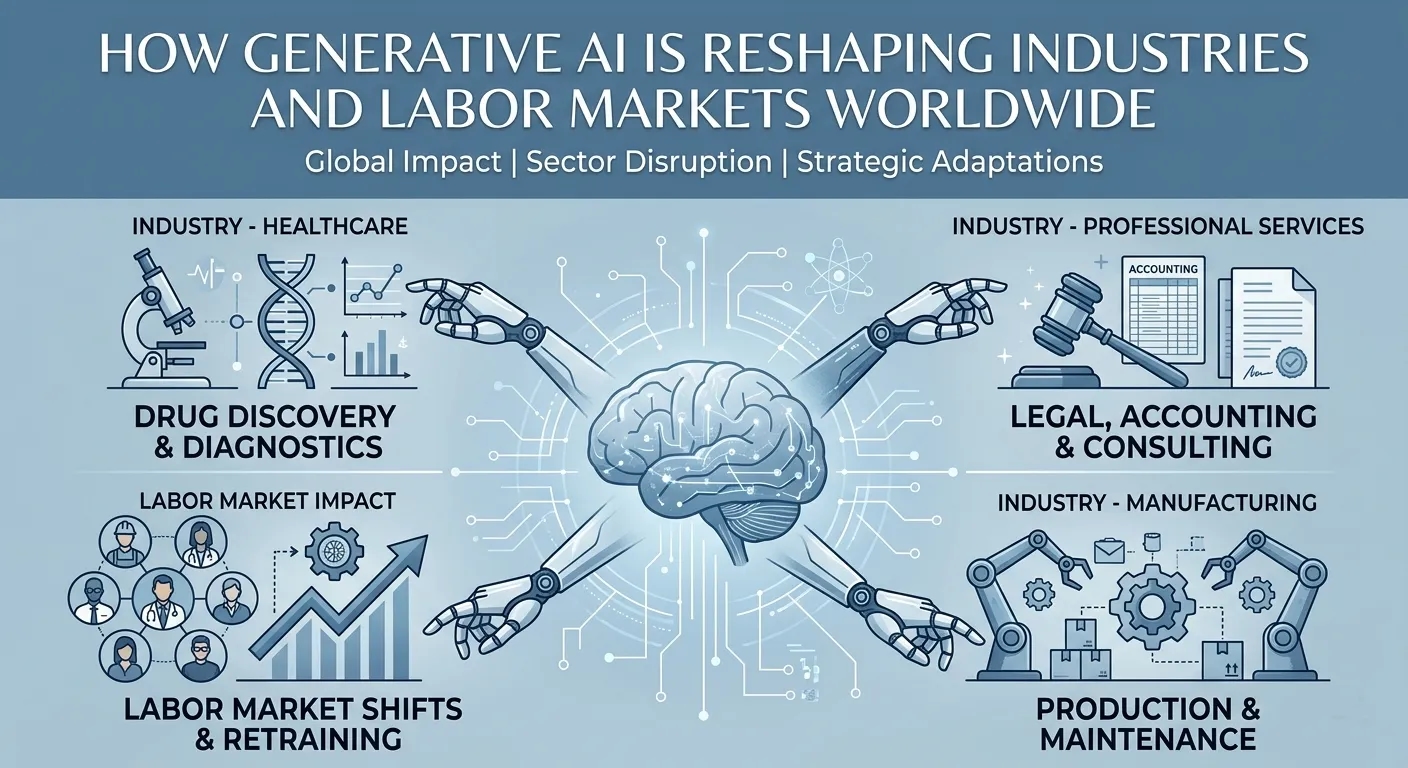
Most technology transitions announce themselves as inflection points while delivering incremental change. Generative AI is doing the opposite. The announcement has been modest by historical standards. The underlying change to the economics of knowledge work is not.
The IMF's April 2025 assessment found that approximately 40% of global jobs face some degree of AI-driven disruption—a figure that rises to 60% in advanced economies. These aren't projections about a distant horizon. They reflect tasks being automated, restructured, or handed to AI-assisted systems in organisations operating today.
Earlier automation waves targeted physical and repetitive tasks. Generative AI competes directly with knowledge work—the drafting, synthesis, analysis, and design that constituted the defensible core of white-collar employment. It can produce a first-draft legal brief, summarise a complex regulatory filing, write production-ready code, or generate financial analysis at a cost that approaches zero once a model is trained.
That changes the economics not of individual tasks but of entire job functions. The question for organisations is no longer which tasks can be automated. It's which activities still require human judgment at a price point that makes the employment model viable. That's a harder question, and most organisations haven't answered it yet.
In professional services, McKinsey estimates that roughly 44% of legal tasks carry meaningful automation potential. Accounting and audit teams are using AI to detect anomalies, prepare filings, and draft regulatory submissions. Consulting firms are deploying AI-generated research as a substitute for the analytical work junior staff once performed. The effect isn't a disappearance of professional roles—it's a compression of the labour pyramid, with fewer people required to produce the same output.
In healthcare and life sciences, drug discovery workflows that once measured in years are compressing. AI-assisted molecular simulation and protein-folding analysis are enabling researchers to test compound candidates without the physical constraints of wet-lab experimentation. Lena Söderqvist, a computational biologist at a Stockholm-based biotech, described the shift plainly: her team now runs experiments in software that previously required months of laboratory queuing. Diagnostic imaging is following the same trajectory, with AI tools achieving specialist-level detection accuracy in specific clinical conditions.
In manufacturing, Siemens and GE are deploying AI co-pilots to support field engineers in real-time fault diagnosis and maintenance scheduling. Inventory systems that operated on weekly batch cycles are updating continuously against live demand signals. Production planning is following—AI is beginning to write machine instructions and optimise factory layouts, compressing design-to-manufacture cycles in ways that reduce both cost and waste simultaneously.
The World Economic Forum estimates that more than 300 million full-time equivalent roles will be materially affected by AI by 2030. The OECD places more than one in four jobs in developed economies at elevated automation risk. Both estimates carry the standard caveats about forecasting technology transitions—automation has historically created work categories that didn't previously exist. But the pace of this transition and the scope of affected occupational categories are both wider than in previous cycles, and the work at risk is higher up the skills ladder.
The experience in India is instructive. NASSCOM estimates the generative AI market there could reach $17 billion by 2027. The traditional model—absorbing offshore services work at cost advantage—is being challenged by AI tools that replicate comparable output at lower marginal cost. India's technology sector has responded by investing in AI capability, building the capacity to deliver AI-enabled services rather than defending substituted workflows.
IBM and Accenture—organisations that advise clients on workforce transformation while facing it internally—have each built structured programs to retrain employees for AI-augmented roles. That those programs exist at scale reflects the magnitude of what organisations now need to navigate.
More than $30 billion was invested in generative AI companies in 2024. Enterprise software investment has realigned accordingly: Microsoft, Salesforce, and Oracle have each rebuilt core products around AI capabilities, shifting toward usage-based pricing that ties customer cost to AI-generated output rather than seat licences. The physical infrastructure requirements of AI at scale matter for investors tracking adjacent sectors. Training large models is energy and compute intensive, and demand for high-performance data centres has made power infrastructure a consequential position in any AI-linked portfolio.
The organisations navigating this transition most effectively aren't simply automating what they already do. They're using the disruption to identify which of their activities generate differentiable value—and competing on proprietary data, domain knowledge, and customer relationships rather than the generic capabilities that AI is rendering cheap.
Building responsible AI governance is also moving from ethical aspiration to operational necessity, particularly in regulated sectors. Explainability, auditability, and bias management are now requirements that procurement and compliance teams factor into vendor selection.
Latest Blogs
2026-08-09T18:30:00.000Z

2026-08-07T18:30:00.000Z

2026-08-07T18:30:00.000Z



