
2026-08-09T18:30:00.000Z
Jun 13, 2026 Blog
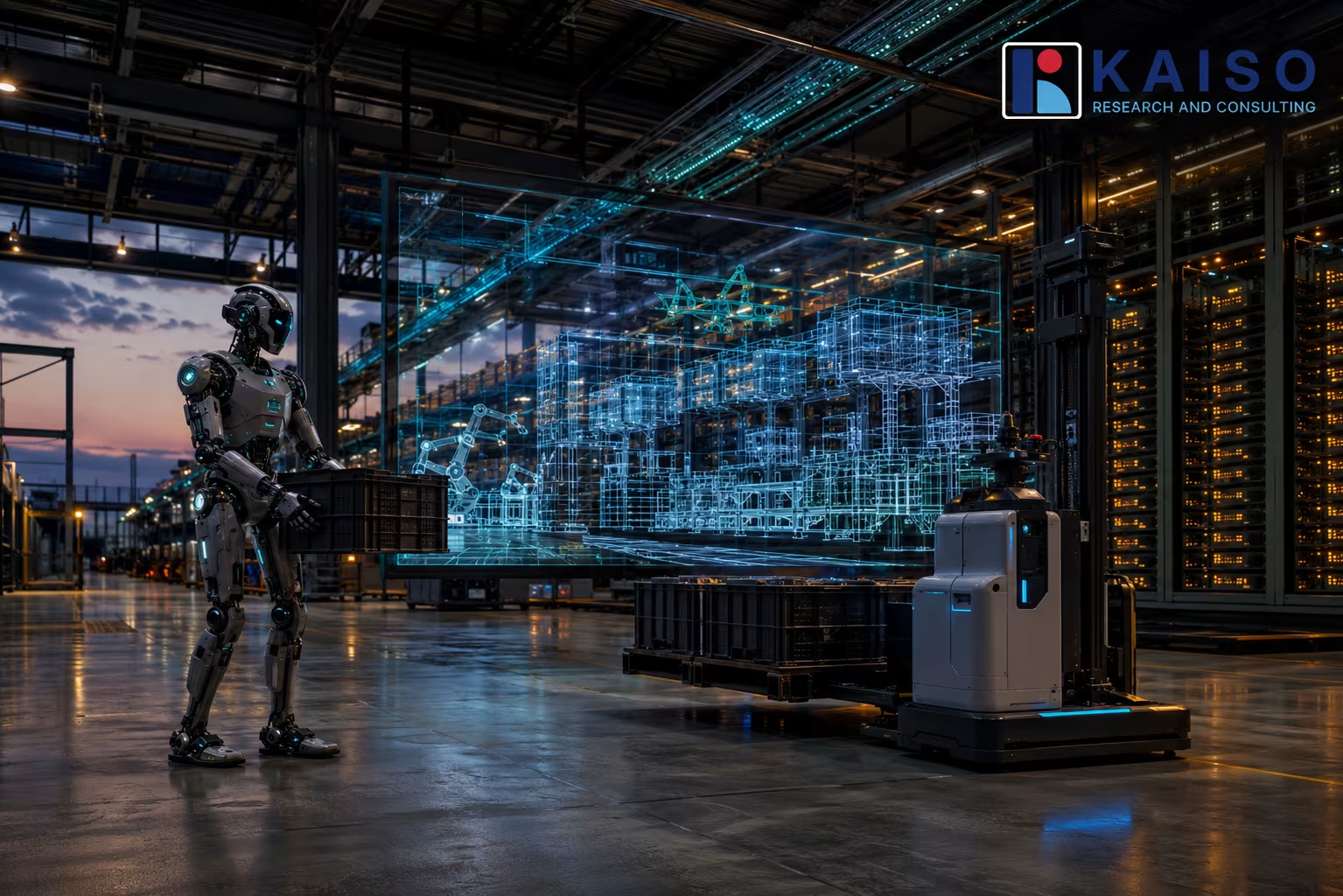
The USD 1.2 trillion committed to U.S. manufacturing and production capacity in 2025 is not a policy headline. It is procurement demand flowing directly into Physical AI Infrastructure budgets at companies that have never before bought GPU clusters, synthetic data platforms, or digital twin simulation licenses. That demand signal is what the 36.53% CAGR in Kaiso Research's primary dataset reflects. It's structurally different from every prior AI infrastructure build-out cycle.
Physical AI Infrastructure is the foundational technology layer enabling robots, autonomous vehicles, drones, industrial machines, and intelligent physical systems to perceive, reason, learn, and act in real-world environments. The market spans compute infrastructure including GPU clusters and AI factories; simulation infrastructure covering digital twins and virtual training environments; data infrastructure for synthetic data and sensor pipelines; networking infrastructure for high-speed interconnects and edge networking; and deployment infrastructure across cloud, on-premises, and hybrid configurations. These five types do not function independently. They are a stack, and the companies that control the full stack are writing the commercial rules for an industry still in its first decade of serious deployment.
The decision before enterprise technology leaders, manufacturing CIOs, and autonomous vehicle program directors is not whether to buy into Physical AI Infrastructure. The decision is which stack layer delivers the most durable competitive position, and whether current platform concentration around NVIDIA, Microsoft Azure, Google Cloud, and Amazon Web Services creates a structural dependency that procurement teams have not modeled into their 5-year capex.
Physical AI Infrastructure does not have a simple layer model. A GPU cluster without a simulation environment trains against data that cannot replicate real-world variability. A simulation environment without edge compute cannot close the deployment gap between virtual and physical operation. A digital twin without a data infrastructure pipeline degrades into a static rendering rather than an active operational tool. Kaiso Research's primary dataset across companies in this segment puts the 2025 valuation at USD 13.45 billion, with the compound rate through 2035 at 36.53%, placing Physical AI Infrastructure among the fastest-growing technology investment categories globally.
The compute infrastructure layer is currently the highest-volume spending category. NVIDIA's GB200 NVL72 and Blackwell architecture configurations are the GPU clusters anchoring industrial AI factory build-outs at Hyundai Motor Group, Samsung Electronics, and Foxconn's manufacturing campuses. Hyperscalers are also running at capacity: global cloud infrastructure services spending hit USD 110.9 billion in Q4 2025, up 29% year-on-year, with Google Cloud recording 50% growth and Microsoft Azure posting 39% in the same quarter. That infrastructure underpins the cloud deployment model that currently dominates Physical AI adoption, but the architecture decision that matters most for this market is what happens at the edge: the deployment layer closest to the machine.
Edge compute is where Physical AI Infrastructure diverges from general AI workloads. A large language model can tolerate round-trip cloud latency measured in seconds. A surgical arm executing spinal procedures, an autonomous forklift navigating a live warehouse, or an Atlas robot performing unscripted factory tasks cannot. NVIDIA's Jetson AGX Thor modules, already integrated into LEM Surgical's Dynamis Robotic Surgical System and deployed at NEURA Robotics' industrial and domestic service platforms, represent the compute infrastructure that sits at the machine itself. That category, edge AI compute, will accelerate fastest within the broader Physical AI Infrastructure market through 2035 as deployment volumes scale beyond the structured pilot environments that have characterized adoption through early 2026.
The simulation infrastructure layer is where the most concentrated platform power currently sits. NVIDIA Omniverse, Isaac Sim, and the Cosmos world foundation model platform form an integrated suite that over 500 developers had enrolled in by early 2025. FANUC, ABB Robotics, YASKAWA, and KUKA, four companies with a combined global robot install base exceeding 2 million units, are integrating NVIDIA Omniverse libraries and Isaac simulation frameworks into their virtual commissioning solutions. That integration decision effectively standardizes the simulation infrastructure stack for the world's largest industrial robot installed base, creating a recurring upgrade cycle whose revenue implications extend across the full 2026–2035 forecast period.
NVIDIA's full-stack position is the most documented fact in Physical AI Infrastructure, but the competitive forces below that stack deserve equal attention from anyone structuring a technology procurement in this category.
The March 2025 announcement of NVIDIA Omniverse Blueprints integration with Ansys, Siemens, SAP, and Schneider Electric defined the enterprise software layer of Physical AI Infrastructure. These four companies serve the simulation, industrial automation, ERP, and energy management functions that manufacturing enterprises run as core operations. By embedding Omniverse into those existing vendor relationships, NVIDIA moved Physical AI Infrastructure from a standalone procurement decision into an extension of contracts that Fortune 500 manufacturers already maintain. Samsung Electronics announced in March 2026 its strategy to transition all manufacturing operations to AI-driven factories by 2030 using digital twin simulations built on NVIDIA's platform. Hyundai Motor Group is building an NVIDIA AI supercomputer to accelerate model training for in-vehicle AI, autonomous driving, smart factories, and robotics.
Google's strategic response is materially different. In February 2026, Google folded Intrinsic, its robotics software subsidiary, out of the experimental Other Bets division into the core business. Intrinsic's Flowstate platform handles motion planning, machine learning integration, and task orchestration across different manufacturers' hardware, allowing a factory to swap robot arms from FANUC, Universal Robots, and KUKA while keeping the same software running operations. The May 2026 announcement of FANUC's Google partnership, integrating Intrinsic's platform into FANUC's 1.1 million robot global install base, established a direct competitive challenge to NVIDIA's simulation-centric approach. FANUC's install base is an upgrade opportunity that no amount of new robot sales can match: if even a fraction of those machines receive AI software upgrades through Intrinsic, Google's physical AI infrastructure revenue scales in a manner orthogonal to GPU procurement cycles.
Microsoft Azure's positioning is infrastructure-as-a-service at hyperscale. The company is running at a USD 145 billion annualized capital expenditure rate, driven by Azure cloud platform expansion, custom Maia silicon procurement, and a global data center footprint that serves Physical AI simulation workloads at the cloud deployment layer. Deloitte's March 2026 opening of a Physical AI Centre of Excellence in Shanghai, built on NVIDIA Omniverse Libraries and serving manufacturing enterprises across Asia-Pacific, signals how enterprise consulting is now organizing around Physical AI Infrastructure as a billable practice, not a speculative pilot program. Deloitte's State of AI in the Enterprise report found 58% of companies are already deploying physical AI to some extent.
The segment that most procurement teams underweight is the robot brain developer layer. Skild AI closed near USD 1.4 billion in funding at a valuation above USD 14 billion in January 2026. Physical Intelligence raised over USD 400 million in 2025 with Bezos Expeditions, NVIDIA, and Temasek as investors. NEURA Robotics is raising up to USD 1.4 billion in Series C funding. These are not hardware companies. They are building the AI software that runs on Physical AI Infrastructure: the models that determine what compute specifications, simulation fidelity, and data infrastructure requirements industrial deployments actually require at scale.
The growth rate in Kaiso Research's primary dataset is not a modeled extrapolation from prior adoption curves. It reflects four structural forces that are simultaneously active and mutually reinforcing.
The most notable competitive divergence in Physical AI Infrastructure in 2026 is not between companies. It's between deployment architectures.
Cloud-dominant deployments, which currently lead adoption, optimize for training infrastructure and model iteration. AWS Project Rainier in Indiana, built on nearly half a million Trainium2 chips across 1,200 acres, exemplifies this architecture. It serves training workloads for foundation model development, including Anthropic's models. Microsoft Azure's Fairwater AI data center in Mount Pleasant follows the same pattern. These facilities are optimized for training the models that Physical AI deployment infrastructure subsequently runs, not for the deployment itself.
The hybrid and on-premises deployment models are where Physical AI Infrastructure differentiation is forming. Hyundai Motor Group's NVIDIA AI supercomputer represents a proprietary build inside the enterprise. Samsung's digital twin infrastructure at its global fabs runs on NVIDIA Omniverse with CUDA GPU-accelerated computational lithography, achieving 20x performance gains in chip manufacturing simulations. These installations are not replaceable by public cloud capacity because the latency, data sovereignty, and operational continuity requirements of manufacturing environments create hard constraints that hyperscaler SLAs cannot accommodate.
The defence segment presents the most structurally distinct procurement model in the market. The EU AI Act's full enforcement beginning August 2, 2026 applies a four-tier risk classification framework to AI systems, and high-risk systems embedded in industrial equipment carry compliance obligations including conformity assessments and CE marking. Military applications sit under a separate exemption, but dual-use systems, including autonomous logistics platforms, inspection drones, and facility management robots deployed across both defence and commercial contexts, face a compliance layer that is reshaping vendor selection criteria. The ISO/IEC 42001 AI management system standard is becoming the audit-grade governance framework that maps EU AI Act, NATO principles of responsible use, and U.S. DoD CMMC 2.0 requirements into a single compliance structure. Procurement teams that ignore this convergence in vendor evaluation are building regulatory exposure into their infrastructure programmes.
Three technical capabilities determine whether a Physical AI Infrastructure investment delivers operational value or remains an expensive pilot.
The first is simulation fidelity at scale. NVIDIA Isaac Sim now includes NuRec neural rendering and new OpenUSD-based robot and sensor schemas. The Omniverse NuRec rendering is integrated in CARLA, an open-source simulator used by over 150,000 developers. World Labs is using Isaac Sim to validate its generative world models. The operational implication is that simulation quality is no longer binary. Systems that cannot generate physically accurate synthetic data at sufficient volume cannot close the gap between lab performance and factory floor performance. Organizations evaluating Physical AI Infrastructure vendors should require demonstrated fidelity benchmarks against their specific industrial environment, not generic capability claims.
The second is edge inference performance. NVIDIA's 800V HVDC architecture is advancing AI factory power delivery to megawatt scale, directly reshaping data center infrastructure specifications globally. At the machine level, Jetson AGX Thor modules running real-time AI inference are the deployment standard for current-generation surgical robots, humanoid platforms, and industrial cobots. The inference performance per watt at the edge determines how many deployed units an organization can operate within a given power envelope, a constraint that becomes binding at scale far earlier than most enterprise technology teams model.
The third is multi-modal sensor fusion. Autonomous vehicles, drones, and humanoid robots require fusion across LiDAR, camera, radar, and proprioceptive sensor streams. The infrastructure that manages this fusion, in both training and real-time inference, is a distinct technical capability from language model inference, and the companies building it are competing on data pipeline architecture as much as on model quality. Aurora Innovation's commercial self-driving trucks running freight between Dallas and Houston, and Waymo's 500,000-plus weekly paid rides from its 3,000-plus robotaxi fleet, are deployments where sensor fusion infrastructure is working at commercial scale.
NVIDIA holds the most complete platform position across deployment segments, but competitive positions diverge sharply by application.
In humanoid robotics, Figure AI at a USD 48 billion private valuation and Boston Dynamics with its production-ready electric Atlas represent the two most commercially advanced deployment programs. Figure has commercial deployments at Amazon, BMW, and Mercedes-Benz. Boston Dynamics deployed Atlas at Hyundai facilities in 2026. Airbus is using UBTECH's Walker S2 humanoid for aviation manufacturing. BMW became the first automaker to deploy humanoid robots in active production in Germany. Each deployment requires Physical AI Infrastructure: compute for training, simulation for policy validation, and edge compute for deployment.
In autonomous vehicles, Waymo, Wayve, and Waabi together raised USD 18 billion in Q1 2026 and are already operating at commercial scale. Private equity investment in autonomous vehicles hit USD 23.26 billion in the first four months of 2026, more than double all of 2025. Wayve's USD 8.6 billion post-money valuation after a USD 1.2 billion Series D reflects investor confidence that embodied AI in autonomous driving is crossing from R&D into recurring revenue. The infrastructure stack for autonomous vehicles, covering high-density sensor data pipelines, simulation environments for rare-event coverage, and edge AI compute for real-time decision making, is a mature procurement category. The infrastructure decisions for 2026 to 2030 autonomous vehicle programs are being made now, against budget cycles that will not reopen for 3 to 5 years.
In industrial automation and warehouse robotics, Amazon, DHL, and Ocado are qualifying humanoid robots for structured warehouse operations. Amazon's Sequoia system increased warehouse efficiency by 75% according to reported figures. KION Group is creating large-scale, physics-accurate warehouse digital twins to train and test fleets of Jetson-based autonomous forklifts for GXO, the world's largest pure-play logistics provider. The infrastructure requirement here is particularly data-intensive: warehouse environments generate continuous operational telemetry that both trains ongoing model improvements and feeds fleet management systems across thousands of deployed units.
The current Physical AI Infrastructure investment cycle has two characteristics that procurement teams need to model into their strategic planning rather than treating them as external market noise.
Platform consolidation is happening faster than most enterprise technology cycles. NVIDIA's Open Cosmos 3.0, the NVIDIA Physical AI Data Factory Blueprint, and the NVIDIA Omniverse DSX Blueprint for AI factory digital twin simulation was all released at GTC 2026 in March. The pattern of releasing platform components faster than enterprise technology teams can evaluate and integrate them is a deliberate market strategy: organizations that defer platform decisions while waiting for "the market to mature" are in practice ceding their roadmap to vendors whose partner relationships are already locked in through pilot programs and existing integrations.
North America holds the largest regional share of Physical AI Infrastructure procurement, but Asia-Pacific is the fastest-growing region. Deloitte specifically cited Shanghai as the intersection of advanced manufacturing, industrial robotics, and global supply chains in justifying its Physical AI Centre of Excellence location. China's National Development and Reform Commission issued directives in June 2024 encouraging humanoid robot development based on large-scale AI models. AGIBOT, listed among NVIDIA's partner network at GTC 2026, represents China's emerging capability in this category. Organizations that evaluate Physical AI Infrastructure exclusively through a North American or European lens are modeling a market that does not reflect where deployment density is highest.
For technology companies and cloud service providers, the Physical AI Infrastructure market represents the most major new compute demand category since the training infrastructure build-out of 2022 to 2024. The differentiation has shifted: pure GPU provision is a commodity play at scale, while simulation platforms, synthetic data generation, and edge compute management tooling hold the highest-margin positions. AWS's Project Rainier, Google's Intrinsic integration with FANUC's 1.1 million robot install base, and Microsoft Azure's AI Foundry expansion all reflect this positioning race. Technology companies without an established Physical AI Infrastructure practice need to recognize that the customer relationships forming now around pilot programs are the equivalent of early enterprise cloud relationships from 2010 to 2014. They compound in the same structural way.
For manufacturing enterprises, automotive OEMs, and logistics providers, the decision is not whether to build Physical AI Infrastructure but whether to build it on proprietary, licensed, or hybrid terms. Samsung's 2030 strategy uses NVIDIA's platform but Samsung controls the manufacturing data that trains its models. Hyundai is building its own NVIDIA AI supercomputer rather than consuming AI compute as a cloud service. These are not cost optimization decisions. They are data sovereignty decisions with 10-year implications for which company controls the operational intelligence generated by millions of deployed robotic and autonomous systems. The enterprises that allow their Physical AI Infrastructure decisions to default to public cloud consumption are making a data sovereignty choice by inaction.
The 36.53% CAGR in Kaiso Research's primary dataset reflects demand-side momentum with genuine structural support. It does not capture three risk categories that will bifurcate the market by 2028.
Power infrastructure is the binding constraint that no simulation can solve. NVIDIA's 800V HVDC architecture advances AI factory power delivery to megawatt scale, which means the largest Physical AI Infrastructure deployments require power grid connections that most industrial facilities were not built to accommodate. The 2-to-3-year lead time for new data center power infrastructure documented in AI infrastructure analysis applies equally to on-premises AI factory build-outs. Organizations planning Physical AI deployments in existing facilities need power studies running in 2026 for capacity that will be operational by 2028 or 2029.
The EU AI Act's August 2, 2026 full enforcement creates a compliance overhead that is not uniformly priced into Physical AI Infrastructure vendor contracts. High-risk AI systems embedded in regulated products face an extended transition period until August 2, 2028 under the AI omnibus amendments adopted in November 2025. But the procurement decisions that will determine which systems are classified as high-risk are happening now, and the conformity assessment process is not fast. Organizations that have not mapped their Physical AI deployments against the EU AI Act's Annex III risk categories are building regulatory uncertainty into programmes whose capital commitments are already being made.
The sim-to-real gap is narrowing but not yet closed for unstructured environments. Deloitte's March 2026 data shows only 5% of firms say Physical AI is transforming their organization, though 41% expect it to within three years. That gap between current and expected transformation is the execution risk embedded in every Physical AI Infrastructure procurement decision. Vendors who close the simulation fidelity gap fastest in unstructured industrial environments, not in controlled warehouse settings or structured automotive assembly lines, will determine which deployment programmes deliver ROI in their projected timeframes.
Kaiso Research's primary dataset projects Physical AI Infrastructure reaching USD 302.69 billion by 2035. The most consequential transition between 2026 and 2030 is the shift from proof-of-concept and structured-environment deployment to generalized deployment across unstructured commercial environments. That shift is where the current stack architecture will face its most serious test.
The companies that control the simulation infrastructure will determine whether and when the sim-to-real gap closes at scale. The companies that control edge compute will determine the unit economics of deployment at the machine level. And the enterprises that have built proprietary data infrastructure from current deployments will hold a model training advantage that widens as operational data accumulates. The infrastructure layer that a company controls in 2026 is the competitive asset they will defend in 2030. This market does not offer a second entry point at the same terms.
About Kaiso Research and Consulting
Kaiso Research and Consulting is a global market intelligence firm publishing 5,000+ research reports across 11+ industry verticals.
kaisoresearch.com | [email protected] | +1 872 219 0417
Lead Industry Analyst, Kaiso Research and Consulting | Covering technology infrastructure and industrial automation markets across North America, Europe, and Asia-Pacific
Published: 2026-06-12 | Report Code: IMEC1136
Sample Report Available at: https://www.kaisoresearch.com/report-store/global-physical-ai-infrastructure-market/sample-request
Latest Blogs
2026-08-09T18:30:00.000Z

2026-08-07T18:30:00.000Z

2026-08-07T18:30:00.000Z



