
2026-08-09T18:30:00.000Z
May 22, 2026 Blog
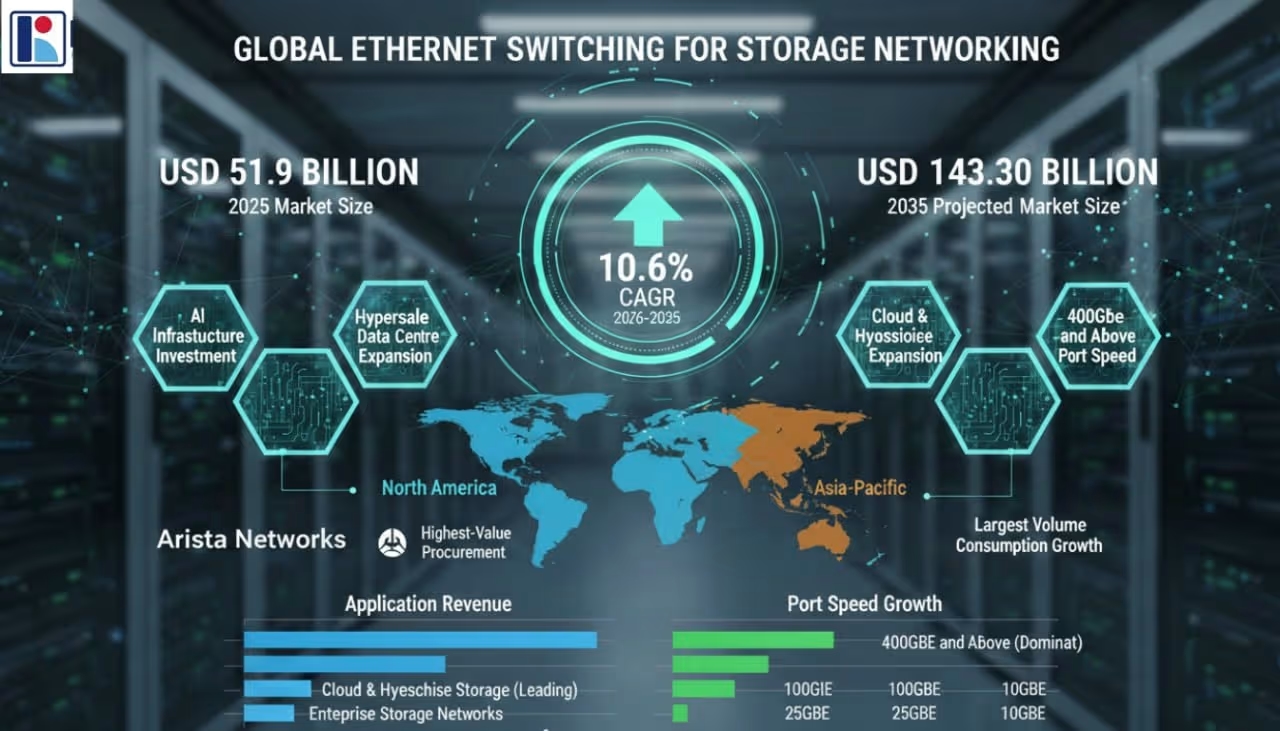
The architecture of storage networking is entering a structural transition. For more than two decades, enterprise storage environments relied heavily on dedicated storage interconnects such as Fibre Channel to deliver deterministic performance and low-latency data movement. That model is now being challenged by the rapid expansion of AI workloads, hyperscale infrastructure, NVMe-based architectures, and high-speed Ethernet fabrics.
Modern storage environments are no longer isolated systems supporting transactional databases alone. They now underpin GPU clusters, AI training pipelines, distributed inference environments, large-scale analytics systems, cloud-native workloads, and data lake infrastructures. As storage traffic patterns evolve, Ethernet switching has emerged as a foundational layer enabling scalable, software-defined, and high-bandwidth storage networking.
According to Kaiso Research, the Global Ethernet Switching for Storage Networking Market is transitioning from a niche infrastructure segment into a strategic growth category shaped by AI infrastructure expansion, NVMe-over-Fabrics adoption, and the growing convergence of storage and data center networking.
Historically, storage networking environments prioritized reliability and isolation over flexibility. Fibre Channel dominated enterprise SAN deployments because it offered predictable latency, mature management ecosystems, and workload stability. However, the economics and scalability limitations of dedicated storage networks are increasingly difficult to justify in modern AI-centric data centers.
The emergence of Ethernet-based storage fabrics has fundamentally altered infrastructure planning.
Technologies such as iSCSI initially demonstrated that Ethernet could support enterprise storage traffic at scale. While early deployments focused primarily on cost optimization, the next phase of market evolution is being driven by performance-centric workloads rather than simple infrastructure consolidation.
Today, organizations are deploying:
This shift is expanding the addressable market for Ethernet switching inside storage-centric environments.
One of the most significant developments influencing Ethernet switching demand is the rapid deployment of AI and machine learning infrastructure.
AI clusters generate entirely different traffic patterns compared to traditional enterprise applications. GPU-intensive environments require continuous movement of massive datasets between compute nodes, distributed storage systems, and AI data lakes. This creates sustained east-west traffic loads that place extraordinary pressure on storage fabrics.
In AI environments, storage performance is no longer a secondary consideration. GPU utilization rates are directly affected by storage throughput and network latency.
As a result, enterprises and hyperscalers are increasingly investing in:
The growth of generative AI workloads are further accelerating this transition. Large language model training environments require ultra-fast movement of training datasets across storage systems, creating new infrastructure spending opportunities for Ethernet switch vendors.
The migration from legacy storage protocols toward NVMe-oF represents one of the most important technology transitions within storage networking.
Traditional storage protocols were designed for hard disk-based architectures with comparatively slower latency requirements. NVMe fundamentally changes storage performance expectations by enabling flash storage systems to operate at significantly lower latency and higher throughput.
However, NVMe’s full performance potential can only be realized through equally capable networking infrastructure.
This is where Ethernet switching becomes strategically important. Modern NVMe-oF deployments increasingly rely on Ethernet-based transport technologies because they provide:
As enterprises modernize storage architectures, Ethernet switching demand attributable to NVMe-oF environments is expected to rise substantially throughout the forecast period.
Despite the industry focus on NVMe-oF and AI fabrics, iSCSI remains an important component of the storage networking ecosystem.
A substantial installed base of enterprise storage environments continues to rely on iSCSI due to its cost efficiency, operational familiarity, and compatibility with existing Ethernet infrastructure.
The persistence of iSCSI deployments creates a sustained revenue opportunity for Ethernet switching vendors through:
The market therefore reflects a dual-transition environment:
1. Legacy enterprise iSCSI infrastructure continues generating steady Ethernet switching demand.
2. Next-generation AI and NVMe-oF architectures are creating entirely new categories of high-speed switching requirements.
This layered demand structure significantly expands the total addressable market for Ethernet switching within storage networking.
The competition between Ethernet and InfiniBand has become a defining strategic issue within AI infrastructure design.
InfiniBand has traditionally maintained an advantage in ultra-low-latency HPC environments. However, Ethernet is rapidly gaining momentum due to advances in:
Hyperscale operators increasingly favor Ethernet-centric architectures because they simplify operational management across compute, storage, and networking domains.
At the same time, Ethernet’s expanding ecosystem support allows enterprises to avoid vendor lock-in while scaling AI infrastructure more flexibly.
This does not imply that InfiniBand disappears from the market. Instead, the industry is moving toward workload-specific deployment models where Ethernet increasingly dominates mainstream AI storage networking environments while InfiniBand remains concentrated in highly specialized HPC workloads.
Port-speed migration represents another major structural driver. As storage-intensive AI environments expand, traditional 10GbE architectures are becoming insufficient for modern data movement requirements. Organizations are rapidly migrating toward:
The transition is especially visible in hyperscale storage fabrics and AI cluster deployments where bandwidth density directly affects workload efficiency.
High-speed Ethernet adoption is also being reinforced by:
This transition materially increases revenue opportunity per deployment because higher-speed switching environments require premium switching silicon, advanced optics, greater power density, and more sophisticated fabric architectures.
The competitive environment within Ethernet switching for storage networking is evolving rapidly as vendors reposition around AI infrastructure growth opportunities.
Major participants include:
Competition is increasingly centered around:
Vendors capable of aligning Ethernet switching portfolios with AI infrastructure requirements are expected to capture disproportionate growth opportunities over the next decade.
The broader market narrative is no longer solely about storage connectivity. Ethernet switching for storage networking is becoming part of a much larger transformation involving:
• AI infrastructure scaling
• Data center modernization
• GPU cluster deployment
• Hyperscale networking expansion
• High-performance distributed storage
• Software-defined infrastructure
• Cloud-native storage architectures
As AI workloads continue increasing infrastructure complexity and bandwidth intensity, storage networking will become increasingly central to enterprise and hyperscale infrastructure planning.
This structural evolution positions Ethernet switching not merely as a networking category, but as a strategic enabler of next-generation compute infrastructure.
The Ethernet switching for storage networking market is entering a long-duration infrastructure expansion cycle driven by AI, NVMe-over-Fabrics adoption, hyperscale scaling, and high-speed Ethernet deployment.
These forces are materially expanding the total addressable market for Ethernet switching within storage-centric environments. Organizations that previously viewed storage networking as a back-end infrastructure layer are now recognizing it as a critical determinant of AI workload performance, infrastructure scalability, and data movement efficiency.
Additional insights are available in the full market study from Kaiso Research – Global Ethernet Switching for Storage Networking Market Report.
Latest Blogs
2026-08-09T18:30:00.000Z

2026-08-07T18:30:00.000Z

2026-08-07T18:30:00.000Z



