
2026-08-09T18:30:00.000Z
Jun 09, 2026 Blog
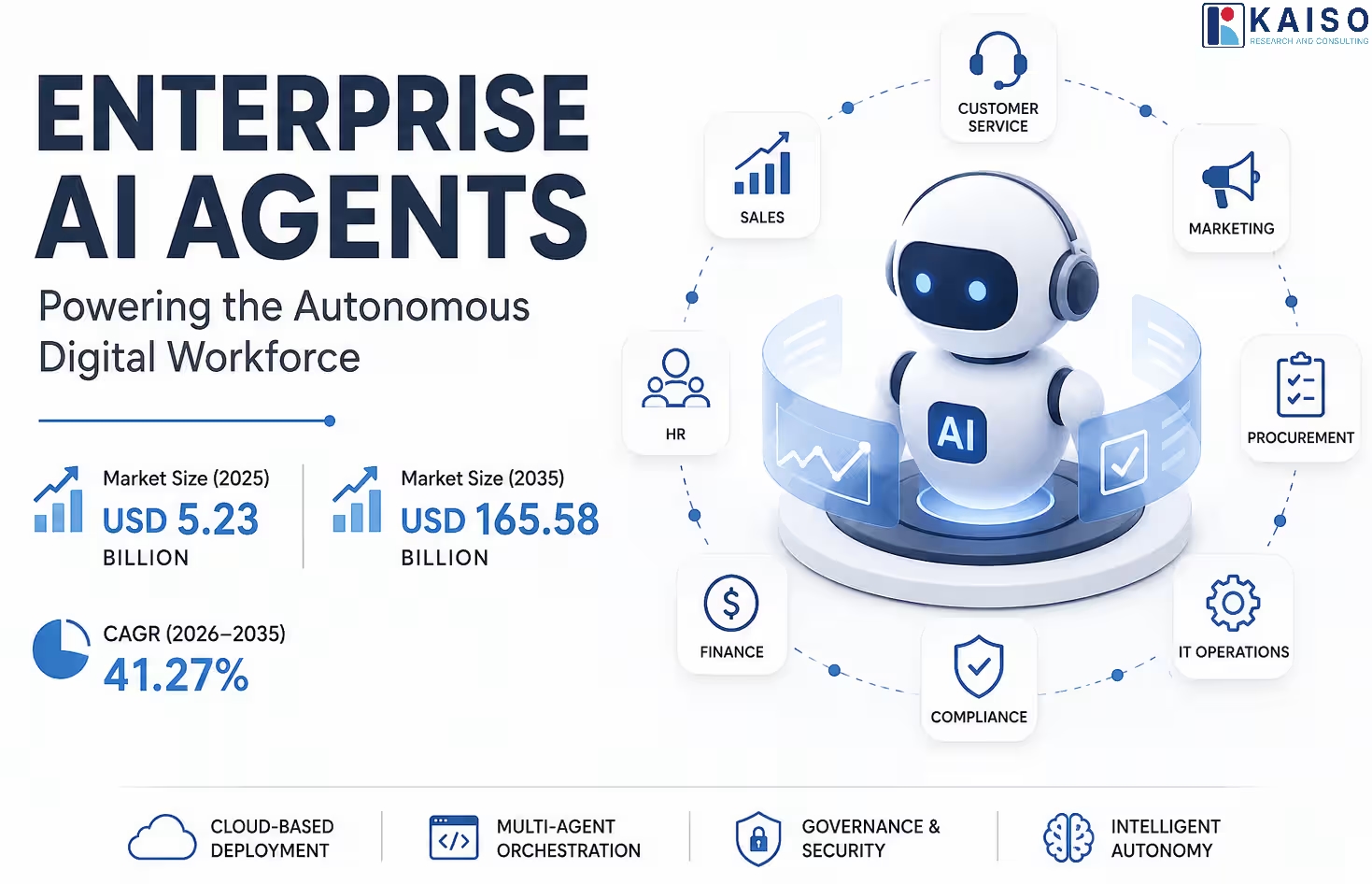
Three years ago, enterprise AI was a chatbot you asked questions. Today, it books the meeting, routes the compliance case, drafts the contract clause, and escalates the exception, all without a human touching the keyboard. The shift from AI as assistant to AI as autonomous operator is not gradual and it is not theoretical. Kaiso Research's primary dataset across 295 companies in this segment puts the 2025 valuation at $5.23 billion and projects $165.58 billion by 2035, a 41.27% compound annual growth rate that places this market among the fastest-expanding infrastructure layers in enterprise technology history.
That figure is the output of a structural change, not a demand surge. Three preconditions converged simultaneously: large language models reached the reliability threshold for multi-step reasoning, enterprise SaaS platforms embedded agent infrastructure directly into CRM and ITSM workflows, and regulators in the United States and European Union created compliance-driven urgency that rewards automation over manual processes. CFOs who treated agentic AI as a horizon-three investment in early 2025 are now confronting it as a 2026 procurement decision. The window for a wait-and-see posture has closed.
The Enterprise AI Agents Market did not scale gradually from a small base. It crossed an inflection point between 2023 and 2025 when reasoning capability, platform integration, and commercial packaging aligned within the same procurement cycle.
The first precondition was model capability. Enterprise deployment demands that an agent not just retrieve information but plan sequences, invoke tools, handle exceptions, and return coherent outputs across multi-step processes. GPT-4-class models demonstrated this in 2023; by 2025, Anthropic Claude, Google Gemini, and Amazon Nova had all hit the reliability floor that CIOs require before allowing autonomous agents to touch production systems. The second was platform integration. Salesforce Agentforce, Microsoft Copilot Studio, and ServiceNow's autonomous AI tiers embedded agent infrastructure directly into the software enterprises already use for CRM, ITSM, and workflow management, eliminating the integration overhead that had stalled earlier automation initiatives. The third was financial pressure: a post-pandemic operating environment that forced organizations to reduce headcount while sustaining service capacity made the ROI case for agentic automation computable rather than speculative.
Kaiso Research's primary market data identifies software component revenue, anchored by AI agent platform and orchestration system subscriptions, as the leading revenue source globally. Cloud-based deployment dominates adoption, driven by SaaS platform integration and the accessible infrastructure that hyperscalers including Amazon Web Services, Microsoft Azure, and Google Cloud have made available at consumption pricing. This shift mirrors broader trends detailed in our Global AI as a Service Market study. What that concentration means for enterprise procurement teams is that the build-versus-buy decision now defaults to buy, because every major software vendor has already made the infrastructure investment.
The competitive dynamics in enterprise AI agents are not a startup story. The dominant platforms in June 2026 are Microsoft Copilot Studio, Salesforce Agentforce, ServiceNow, Google Vertex AI Agent Builder, IBM watsonx Orchestrate, and Amazon Bedrock AgentCore. Each reflects a different theory about where enterprise AI agency should live: inside the productivity suite, inside the CRM, inside the workflow platform, or inside the cloud infrastructure layer.
Microsoft Copilot Studio has 160,000 organizations running more than 400,000 custom agents, the highest deployment volume of any agentic platform in 2026. That adoption base reflects the gravitational pull of Microsoft 365: organizations that already pay for Teams, Outlook, and SharePoint can deploy Copilot Studio agents inside existing workflows at $200 per 25,000 credits per month without replatforming. The lock-in is structural, not contractual. Salesforce Agentforce tells a different story. Built on the Atlas Reasoning Engine and reaching $800 million in ARR since launch, Agentforce has closed 29,000 customer deals by leveraging Salesforce's position as the system of record for sales, service, and marketing data. The Einstein Trust Layer applies policy controls, data masking, and audit logging to every agent interaction, addressing the governance gap that keeps procurement teams cautious. Salesforce's November 2025 acquisition of Informatica added enterprise data management capabilities to the stack, directly targeting the data quality problem that determines whether agentic containment rates are acceptable in production.
ServiceNow has restructured its entire commercial model around autonomous AI tiers and received the highest score in the 2025 Gartner Critical Capabilities report for AI Agents in the ITSM category. IBM watsonx Orchestrate leads the governance-first segment: organizations in regulated industries running SAP, Salesforce, or ServiceNow stacks that cannot tolerate explainability gaps in agent decisions. Developer-layer competition is equally concentrated. LangGraph, with 34.5 million monthly downloads and deployments at Klarna, Uber, and LinkedIn, leads open-source adoption.
OpenAI's Agents SDK, released in March 2025, has surpassed 26,900 GitHub stars and 10.3 million monthly downloads. Google's Agent Development Kit introduced A2A protocol support in April 2025, enabling interoperability between agents built on different frameworks. That interoperability matters: enterprise organizations are not deploying single-vendor stacks. These organizations run Microsoft productivity agents alongside Salesforce CRM agents alongside AWS infrastructure agents, and the protocol layer that connects them is a strategic asset.
CAGRs above 40% for a multi-billion-dollar base require structural drivers, not just demand enthusiasm. Kaiso Research's primary dataset identifies four forces that make this projection defensible rather than aspirational.
The first is the shift from proof-of-concept to production deployment. A 2026 survey by BeamSec found that more than half of organizations now deploy AI agents for multi-stage workflows, with 16% running cross-functional processes that span multiple departments. In early 2025, these numbers were single digits. The production transition matters because it activates recurring subscription revenue, platform upsell, and the professional services layer, all of which compound the base market figure annually.
The second force is vertical specialization. Generic enterprise platforms are losing ground to industry-specific agent solutions in BFSI, healthcare, and manufacturing, where workflow nuance is too deep for horizontal tools. The BFSI sector leads end-user revenue, commanding the largest share through finance, compliance, and customer service agent deployments where regulatory precision is non-negotiable. Industry benchmarks from the Global BFSI AI Market verify that healthcare organizations managing clinical decision support and prior authorization workflows represent the fastest-growing vertical segment, driven by staff shortages that have made automation an operational necessity rather than an efficiency target.
Comprehensive tracking in our Global Healthcare AI Market report indicates that this vector will see sustained capital deployment. The third force is multi-agent system adoption. Single-agent deployments handle bounded tasks. Complex business processes, procurement approval chains, regulatory reporting pipelines, and cross-functional IT change management require multiple specialized agents coordinating with shared state, tool access, and handoff protocols. This structural shift is analyzed deeply in the Global Multi-Agent Systems in Artificial Intelligence Market report. That architectural requirement drives higher per-seat revenue, longer sales cycles, and deeper platform lock-in. The fourth is the cost of inaction. Organizations that delay enterprise agent deployment are not maintaining a neutral position. Those organizations fall behind competitors who are compressing cycle times and deploying capital to other priorities.
It's worth noting that the CAGR figure masks a bifurcated adoption curve where large enterprises in BFSI and technology run multi-agent production systems while mid-market organizations are still running proof-of-concept deployments. The aggregate growth rate is real. The experience of any single organization depends entirely on where it sits in that distribution.
Enterprise AI agent platforms operate on a foundation that most procurement discussions underweight: the hyperscaler infrastructure that provides model access, compute orchestration, data storage, and security baseline. According to the latest Global AI Infrastructure Market data, Google Vertex AI Agent Builder's A2A protocol reached production at 150 organizations in 2026, enabling agents built on different frameworks to communicate through a standardized task interface. The Agent Development Kit is available in Python, TypeScript, Go, and Java, supporting native multimodal capability through Gemini's image, audio, and video processing. Amazon Bedrock AgentCore, expanded with Codex integration and broader model availability at AWS's April 2026 event, provides access to Anthropic Claude, Meta Llama, Mistral, and Cohere through a unified API. For engineering teams already operating in AWS, it offers the lowest-friction path to production agent deployment without replatforming. Microsoft Azure AI Foundry integrates GPT-5 through OpenAI partnership, providing the model access layer that underpins Copilot Studio's commercial scale.
The infrastructure competition creates a capability floor that rises every quarter. Organizations that made early bets on a single hyperscaler's agent infrastructure are discovering that architectural decisions made in 2024 are constraining their ability to access models released in 2025 and 2026. Cross-cloud agent interoperability, through standards like A2A and Anthropic's model context protocol, is addressing that constraint, but migration overhead for production agents running at scale is significant. Infrastructure decisions in enterprise AI agents are not like software upgrade cycles. They have the lock-in characteristics of platform decisions.
Only 16% of organizations have a formal strategy and roadmap for implementing AI agents, according to demand research across the sector. Confidence in fully autonomous AI agents has fallen from 43% in 2024 to 22% in 2025. Employee anxiety about agent-driven job displacement affects 61% of organizations. These figures do not describe reluctance to adopt: they describe a governance gap that procurement teams cannot close by buying another platform as outlined in the Global AI Governance Market report.
The EU AI Act's full high-risk AI system compliance deadline is August 2, 2026, with fines reaching EUR 35 million or 7% of global annual turnover for prohibited practices. For enterprise AI agents operating in BFSI credit decisioning, healthcare clinical support, or HR recruitment functions, the EU AI Act's high-risk classification triggers Article 9 lifecycle risk management, technical documentation requirements, human oversight obligations, and registration in EU databases. The U.S. framework is fragmented but not permissive: the OCC requires model risk management for banking AI, the FDA regulates healthcare AI systems, and the SEC scrutinizes algorithmic trading applications.
Organizations deploying agents across North America and Europe simultaneously face multi-jurisdictional compliance stacks that their governance platforms must address before production authorization. The governance-first vendors, Salesforce with its Einstein Trust Layer, IBM watsonx Orchestrate with its audit infrastructure, and ServiceNow with its Control Tower, are winning regulated-industry procurement precisely because these vendors have made compliance evidence a product feature rather than a professional services engagement.
North America holds the largest regional market share through platform vendor concentration: Microsoft, Salesforce, ServiceNow, OpenAI, and Anthropic are headquartered or primarily structured in the United States, which means enterprise procurement in North American BFSI, technology, and healthcare sectors flows through platforms whose roadmaps are set domestically. The U.S. dominated AI funding in 2025, capturing $159 billion, or 79% of global venture capital, with the San Francisco Bay Area alone accounting for $122 billion. That concentration creates an R&D advantage that the North American market monetizes first.
Asia-Pacific sustains the fastest consumption growth throughout the forecast period. Manufacturing-intensive economies in Japan, South Korea, and Southeast Asia face the same labor-cost pressures as Western markets but with higher exposure to automation-amenable repetitive workflows in production, quality control, and supply chain coordination. Retail and e-commerce deployments in China and India are scaling faster than comparable segments in North America, driven by platform investment from Alibaba Cloud, Baidu, and Tata Consultancy Services, which are building agent infrastructure tailored to regional compliance requirements.
Enterprise AI agent deployments in India's BFSI sector, particularly in customer service automation and KYC process agents, are growing at rates that will contribute materially to Asia-Pacific's share of the global forecast by 2030. Germany and France are leading European deployments, though the EU AI Act compliance burden is creating procurement caution that is slowing the adoption curve relative to North American and Asia-Pacific peers.
The enterprise agent market has not consolidated around six platforms. A parallel layer of vertical and function-specific startups is capturing procurement dollars that the horizontal platforms cannot address with sufficient depth.
Glean, valued at $7.2 billion in its Series F, has built an enterprise knowledge agent that indexes and retrieves across internal data sources with governance controls that IT security teams accept. Its deployment at Fortune 500 organizations demonstrates that enterprise search-and-retrieval agents command premium pricing when they reduce the time-to-answer for knowledge worker queries. Sierra, led by Bret Taylor and reaching $150 million ARR in eight quarters (described as the fastest in enterprise SaaS history), is positioning as the customer experience agent standard. Its $950 million Series E round, led by Tiger Global and Google's GV, validates the thesis that vertical focus in customer-facing workflows justifies standalone valuations against Salesforce Agentforce's CRM-native alternative. Distyl AI, funded at $1.8 billion by Lightspeed Venture Partners and Khosla Ventures, is addressing the enterprise AI implementation problem: large organizations that know they need agentic AI but do not have the engineering capacity to deploy it. That services-layer opportunity scales proportionally with market adoption, and this is the least often discussed driver in the market forecast.
The consolidation question is not whether horizontal platforms will win. They already have dominant market share. The question is whether vertical specialists can sustain differentiation long enough to reach the contract depth and renewal rates that make them acquisition targets rather than casualties.
Kaiso Research's primary data identifies three distinct executive roles with immediate exposure to this market shift:
For the Chief Information Officer evaluating platform decisions in 2026: the buy-versus-build question has resolved. Microsoft Copilot Studio and Salesforce Agentforce have achieved the deployment volume and enterprise support infrastructure that internal builds cannot replicate at equivalent cost. The infrastructure decision, cloud vendor, agent framework, and governance platform, carries five-year lock-in risk that procurement teams underweight against immediate integration savings. The CIO who treats this as a standard software evaluation is underweighting the architectural consequences.
For the Chief Financial Officer building the 2027 operating model: the labor substitution math in repetitive workflow categories, finance reconciliation, customer service tier-one resolution, HR onboarding administration, and IT ticket routing, is now computable. Organizations that completed pilot deployments in 2025 are running production agents in 2026. Those that are still in proof-of-concept in mid-2026 are on a deployment timeline that puts them 12 to 18 months behind peers in the same sector.
For the Chief Risk Officer in a regulated industry: the EU AI Act compliance deadline of August 2026 is not a future event. It is a current operational requirement. Agents running in BFSI, healthcare, or HR functions in EU member states require registered risk management documentation, human oversight architecture, and audit trails that many current deployments do not have.
Three structural risks will persist through the forecast period regardless of adoption growth.
The trust deficit is empirical and specific. Confidence in fully autonomous agents fell 21 percentage points between 2024 and 2025 precisely as deployments scaled. The reason is not fear of AI in the abstract: it's production failures, hallucination events in customer-facing deployments, and agent actions that exceeded their intended scope. Platform vendors have responded with governance infrastructure, but the gap between what governance platforms promise and what they enforce in complex multi-agent workflows remains technically unsolved. The skills gap compounds the trust deficit. Deploying enterprise AI agents at production scale requires AI engineers, data architects, and AI governance specialists whose supply is outpaced by demand.
Organizations that cannot hire rarely deploy successfully, and the consulting layer, Distyl AI, Accenture, and Deloitte's AI practices, absorbs margin that the market forecast does not account for. The interoperability problem is architectural. Enterprise organizations running agents across Microsoft, Salesforce, and AWS stacks encounter context loss, authentication failures, and audit gaps at the boundaries between platforms. The A2A protocol and Anthropic's model context protocol are addressing this, but standardization is incomplete and vendor incentives are not uniformly aligned toward interoperability.
Enterprise AI revenue reached $37 billion across all categories in 2025, representing more than 3x year-over-year growth. Within that total, the agent segment identified in Kaiso Research's primary dataset was $5.23 billion, growing at 41.27% annually through 2035 to reach $165.58 billion. The arc from 2026 forward will not be linear. Early years of the forecast will be compressed by the governance gap, the EU AI Act compliance burden, and the implementation debt from proof-of-concept deployments that never reached production.
Years 2028 to 2032 are the compounding phase, when organizations that completed successful production deployments in 2026 and 2027 expand from departmental agents to cross-functional multi-agent systems. The final phase, 2032 to 2035, reflects the vertical specialization layer reaching maturity: industry-specific agent platforms in BFSI, healthcare, and manufacturing commanding premium pricing that the current horizontal platform market cannot sustain.
The organizations that will own the largest share of this market at $165.58 billion are not those moving fastest in 2026. They're those building governance infrastructure now that production agents will require at scale.
The enterprise AI agents market is not a prediction. This is a current operational reality that procurement teams are pricing into 2026 budgets, that CFOs are running against labor cost models, and that regulators are enforcing against compliance timelines. Kaiso Research's primary dataset puts the 2025 valuation at $5.23 billion and the 2035 projection at $165.58 billion. The 41.27% CAGR reflects three simultaneous forces: reasoning capability that reached enterprise reliability thresholds, platform integration that eliminated deployment friction, and regulatory pressure that made the risk of inaction concrete. The executives who treat this as a vendor evaluation are asking the wrong question. The right question is which workflows in their organization will still be human-operated in 2028, and whether that choice was made deliberately or by default.
About Kaiso Research and Consulting
Kaiso Research and Consulting is a global market intelligence firm publishing 5,000+ research reports across 11+ industry verticals.
kaisoresearch.com | [email protected] | +1 872 219 0417
Lead Industry Analyst, Kaiso Research and Consulting | Covering artificial intelligence and enterprise technology markets across North America, Europe, and Asia-Pacific
Published: 2026-06-09 | Report Code: IMEC1146
Sample Report Available at: https://www.kaisoresearch.com/report-store/global-enterprise-ai-agents-market/sample-request
References & Data Sources:
European Commission: Regulatory Framework for AI & The EU AI Act (Regulation 2024/1689)
arXiv Information Retrieval Core: AI Agents Under EU Law: A Compliance Architecture for AI Providers (2026)
Crunchbase Market Intelligence: Global Venture Funding Record Analytics & AI Compute Spending
Firecrawl Developer Network: The Best Open Source Frameworks for Building AI Agents (2026 Metrics)
Menlo Ventures Insights: State of Generative AI in the Enterprise Production Deployment Study
MarkTechPost: Best Enterprise Level Agentic AI Platforms for 2026
Latest Blogs
2026-08-09T18:30:00.000Z

2026-08-07T18:30:00.000Z

2026-08-07T18:30:00.000Z



